
Brake Safety Week 2026 explained
What carriers should know
If you've been through DOT Blitz Week and Operation Safe Driver Week already this year, you might be tempted to think enforcement season is winding down. It isn't.
CVSA Brake Safety Week runs August 23-29, 2026, and it targets one of the most common and consequential out-of-service violations in commercial trucking: brake system defects.
For seven days, trained and certified inspectors across the United States, Canada, and Mexico will conduct roadside inspections with a specific focus on brake components. Vehicles with brake-related violations get pulled until those violations are corrected. No exceptions, no waivers, just equipment off the road and freight that isn't moving.
Here's what Brake Safety Week is, what inspectors are focused on this year, and what carriers need to do.
What Is CVSA Brake Safety Week?
Brake Safety Week is a seven-day focused inspection and enforcement initiative designed to improve safety by ensuring that commercial motor vehicles on our roadways operate with properly maintained, functioning braking systems.
The program is part of CVSA's Operation Airbrake initiative and runs annually across North America. Throughout the week, trained and certified inspectors in Canada, Mexico, and the U.S. conduct routine commercial motor vehicle inspections, focusing on brake systems and components. Vehicles with brake-related out-of-service violations, or any other out-of-service violations, will be removed from roadways until those violations are corrected.
Brake Safety Week isn't just an enforcement event. It also emphasizes education and awareness. Inspectors and officials engage with drivers, motor carriers, and mechanics to highlight the role that proactive vehicle maintenance plays in reducing crashes and saving lives.
When Is Brake Safety Week 2026?
CVSA's Brake Safety Week is scheduled for August 23-29, 2026. That's seven consecutive days of heightened brake-focused inspection activity at weigh stations, fixed inspection sites, and roadside checkpoints across North America.
The timing matters. August is peak summer freight season - flatbed volume is elevated, reefer demand is high, and equipment that's been running hard through the spring and summer is exactly the kind of equipment that accumulates deferred maintenance. Inspectors know this, and Brake Safety Week is positioned accordingly.
What Is the 2026 Focus Area?
Every year, Operation Airbrake designates a specific focus area within brake systems. This year's focus is drums and rotors. Brake drum and rotor issues may affect a vehicle's brake efficiency. Broken pieces of drums and rotors may become dislodged from the vehicle en route, damaging other vehicles or causing injuries or fatalities to the motoring public.
This is worth understanding in concrete terms. A brake drum or rotor isn't just a mechanical component, it's one of the last lines of defense between a loaded commercial vehicle and a catastrophic stopping failure. When drums crack, rotors wear through, or metal-to-metal contact develops because the brake pads are gone, the vehicle's ability to stop safely is compromised in ways that often go undetected by the driver until something goes wrong.
During Brake Safety Week, inspectors will report data to CVSA about vehicle inspections and brake-related violations. CVSA will collect and analyze all submitted brake-related data and release the results later this year.
What Are Inspectors Looking For?
During Brake Safety Week, inspectors will conduct full brake system inspections, with particular attention to drum and rotor condition. Based on CVSA's official guidance for the 2026 campaign, here's exactly what they're checking:
On brake drums:
- Visible cracks or broken pieces in the drum surface
- Cracks that run through to the outer portion of the drum
- Missing pieces, where visible
- Any condition consistent with out-of-service criteria under OOSC Part II
On brake rotors (disc brakes):
- Signs of cracked or broken pieces in the friction surface
- Heavy rust across the entire friction surface - a heavily rusted rotor indicates an inoperative brake
- Grooves indicating metal-to-metal contact, which means brake pads are worn, and the shoe is making direct contact with the rotor
- Wear that exposes the center vents, indicating the rotor has worn beyond serviceable limits
Inspectors will also be checking that any previous repairs are consistent with the brake manufacturer's requirements and guidelines, and that drivers have properly noted issues in their DVIRs and reported them to the motor carrier.
The six conditions CVSA has specifically identified as out-of-service violations this year - broken drums, metal-to-metal contact, worn rotors, cracked rotors, and rusted rotors - are all things that develop gradually under normal operating conditions. That's the point: these aren't freak failures. They're the predictable result of deferred maintenance on equipment that's been running hard.
Why Brake Violations Are So Consequential
Brake defects consistently rank among the most common out-of-service violations in commercial vehicle inspections, and they carry consequences that compound fast.
The immediate impact is an out-of-service order. The truck doesn't move until the violation is corrected, which means freight is delayed, customers are notified, and someone dispatches a mobile repair unit or arranges a tow. Depending on where the vehicle is when it's pulled and how quickly repairs can be arranged, that's anywhere from a few hours to a full day or more of downtime.
The longer-term impact is on your CSA score. Brake violations feed into the Vehicle Maintenance BASIC, and patterns of brake-related violations attract FMCSA attention and insurance scrutiny that persists for months after the inspection event.
For fleets with multiple vehicles in the field during Brake Safety Week, the risk multiplies. A single inspection event with widespread brake violations doesn't just create operational disruption, it creates a record that affects carrier relationships, insurance renewals, and broker qualification criteria.
Brake Safety Week vs. DOT Blitz Week: What's Different?
Carriers who went through DOT Blitz Week (CVSA International Roadcheck) in June might wonder how Brake Safety Week differs. The distinction is in focus and scope.
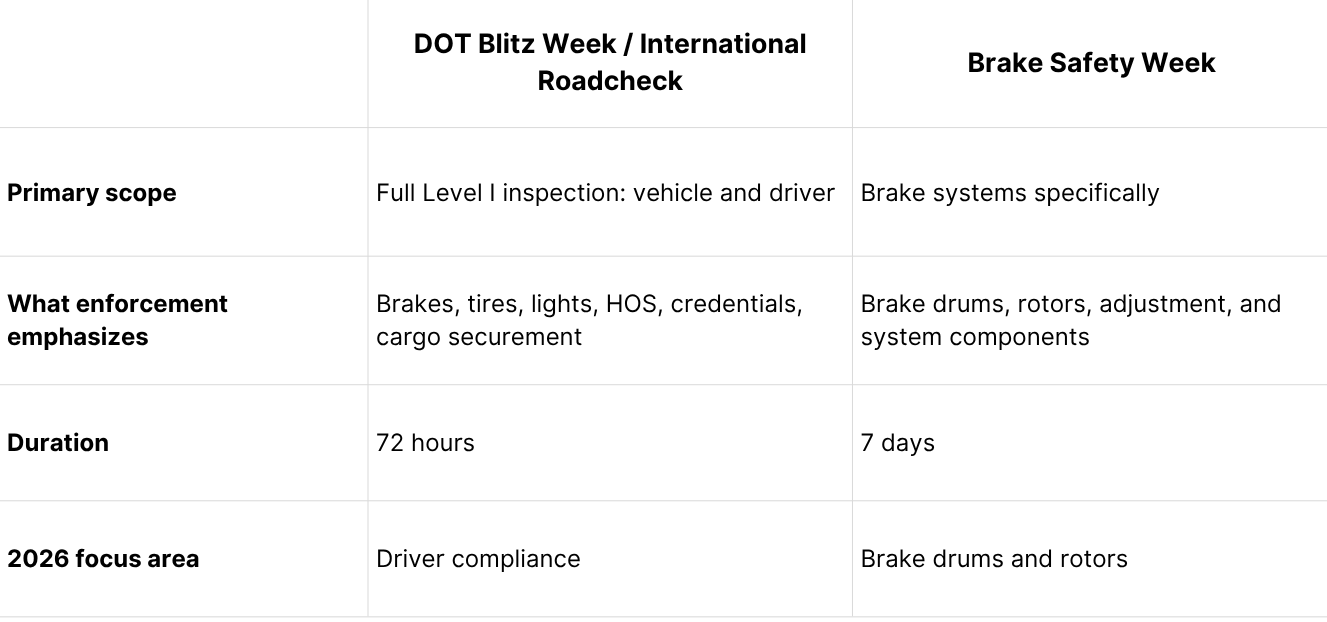
The practical difference: Brake Safety Week isn't a full-vehicle sweep. It's a deep dive into one system. Inspectors who are specifically trained on brake components and specifically looking for brake defects are going to find things that might get less scrutiny during a broader inspection event. If your brake maintenance has been inconsistent, Brake Safety Week is when that gap shows up.
How to Prepare for Brake Safety Week
The preparation that matters most for Brake Safety Week happens before the week starts. Here's where to focus.
1. Pull maintenance records and audit brake service history
When were brake components last inspected on each unit in your fleet? When were pads, shoes, drums, and rotors last replaced or measured? If you don't have clear answers to those questions, that's the first problem to fix. Brake maintenance should be documented, up to date, and traceable.
2. Run a focused pre-inspection on drums and rotors across your fleet
Have a qualified mechanic specifically inspect drum and rotor condition on every unit before the week begins. This isn't the same as a routine pre-trip check. It's a targeted assessment looking for exactly the conditions CVSA has identified: cracks, excessive rust, groove patterns indicating metal-to-metal contact, wear to center vent exposure, and missing pieces. If you're finding these conditions now, you have time to correct them. If an inspector finds them on the road, you don't.
3. Check brake adjustment on all axles
Out-of-adjustment brakes are one of the most common brake-related violations year over year. Brake adjustment degrades gradually with normal use, and it's easy to let it slip between scheduled maintenance intervals. Before Brake Safety Week, verify adjustment is within spec on every axle.
4. Reinforce DVIR discipline with drivers
The CVSA guidance specifically calls out the need to note brake issues in Driver Vehicle Inspection Reports and to report them to the motor carrier. If drivers are glossing over DVIRs as a paperwork exercise rather than treating them as a genuine inspection record, that needs to change before August 23rd - not because an inspector might ask about DVIR history, but because the DVIR process is what catches developing brake problems before they become out-of-service violations.
5. Don't forget trailers
Brake Safety Week covers the full commercial vehicle, including trailers. Trailer brake systems, including drums, rotors, and brake adjustment, are inspected with the same scrutiny as tractor components. Fleets that focus their pre-inspection attention on tractors and overlook their trailer pool are leaving exposure on the table.
Why Trailer Brake Accountability Matters More in Shared Networks
For fleets that operate trailer pools, share equipment across carriers, or access trailers through platforms like REPOWR, Brake Safety Week creates a specific accountability question: who is responsible for the brake condition of a trailer that has changed hands?
The answer, legally and practically, is that the operator who is pulling the trailer at the time of inspection is responsible for its roadworthiness. That makes trailer condition at interchange critically important.
REPOWR's pre- and post-trip inspection workflows, with photo documentation, create a timestamped record of the trailer's condition at every handoff. When a carrier accepts a trailer, they're accepting it in its documented condition, and when they return it, that condition is recorded again. This creates the kind of chain of custody that protects both equipment owners and operators when questions about brake conditions arise.
It also means that trailers accessed through REPOWR are more likely to arrive with a documented maintenance history and a current condition record than trailers picked up informally, which matters during any enforcement week, but particularly during one focused specifically on the component category that generates the most out-of-service violations in the industry.
Brake Safety Is Year-Round Discipline
Brake Safety Week serves as an enforcement event because it focuses inspection resources on a specific system within a defined window. But brake systems don't know what week it is. They degrade continuously, under every load, in every weather condition, across every mile.
Motor carriers and drivers are encouraged to perform thorough pre- and post-trip inspections and ensure all brake components are in proper working condition before operating their vehicles. Brake Safety Week serves as an important reminder that safety is a shared responsibility among drivers, motor carriers, inspectors, and the broader transportation community.
The fleets that come through Brake Safety Week without violations aren't doing anything special that week. They're running the same maintenance discipline they run every other week, and that discipline simply means there's nothing for an inspector to find.
Brake Safety Week is seven days. Brake system maintenance is 365 days. The carriers who understand that distinction come through the week cleanly. It’s not because they got lucky, but because the underlying systems were already in order.
For carriers, fleet managers, and owner-operators, the steps are straightforward: audit brake maintenance records, run a targeted pre-inspection on drums and rotors, verify adjustment across all axles, reinforce DVIR discipline with drivers, and don't overlook trailers. Do those things consistently and Brake Safety Week is just another week on the road.
FAQ: CVSA Brake Safety Week 2026
What is Brake Safety Week?
Brake Safety Week is an annual seven-day inspection and enforcement initiative led by CVSA across the United States, Canada, and Mexico. Inspectors conduct roadside inspections with a specific focus on commercial motor vehicle brake systems, and vehicles with brake-related out-of-service violations are removed from service until violations are corrected.
When is Brake Safety Week 2026?
Brake Safety Week 2026 runs August 23-29, 2026.
What is the 2026 focus area for Brake Safety Week?
This year's focus is brake drums and rotors. Inspectors will be specifically checking for cracked drums, worn or grooved rotors, metal-to-metal contact, heavy rust indicating inoperative brakes, and wear that exposes rotor center vents.
What happens if a vehicle fails a brake inspection during Brake Safety Week?
A vehicle with a brake-related out-of-service violation is removed from roadway operation until the violation is corrected. Beyond the immediate operational disruption, violations contribute to CSA scores under the Vehicle Maintenance BASIC, with downstream effects on insurance, carrier relationships, and broker qualification.
Does Brake Safety Week cover trailers?
Yes. Trailer brake systems, including drums, rotors, and brake adjustment, are inspected with the same scrutiny as tractor components. Operators are responsible for the roadworthiness of any trailer they're pulling at the time of inspection.
How is Brake Safety Week different from DOT Blitz Week?
DOT Blitz Week (International Roadcheck) is a 72-hour event that covers a full Level I inspection, including vehicle condition, driver credentials, HOS, cargo securement, and more. Brake Safety Week is a seven-day initiative focused specifically on brake systems and components, with inspectors specifically trained to identify brake defects.
How should carriers prepare for Brake Safety Week?
Audit brake maintenance records, run a targeted pre-inspection on drums and rotors across your entire fleet, including trailers, verify brake adjustment on all axles, and reinforce DVIR discipline with drivers. Preparation should be complete before August 23rd.
.jpg)
.jpg)
.jpg)
.jpg)


